Ethical Concerns with Computer Vision
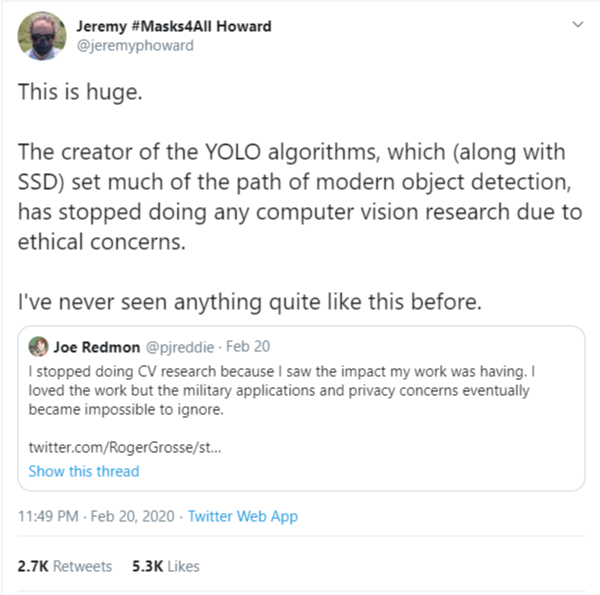
Computer vision is a field in which machine learning methods are combined with sensor systems, particularly cameras, to classify objects without human input. Technology coming from research in this field is incredibly powerful and can have positive or negative impacts. This can be seen in the tweet, by Joe Redmon[1], that is quoted above in which he announced that he would no longer work in the field due to ethical concerns. This sentiment is not exclusive to the field or the current era. Many in research fields grapple with whether to keep developing their particular field when the enhancements can be used very effectively for good but at the same time would be just as effective when used maliciously. This post will discuss the ethical issues of computer vision as well as compare the field to other scientific and technological advancements with serious ethical concerns.
There are a myriad of ethical issues regarding computer vision with surveillance being a prime example. If this surveillance technology combined with facial recognition technology fell into the wrong hands it could very detrimental to a society. Privacy and the right to relative anonymity is at risk when these systems are in place. Facial recognition methods are incredibly powerful and dangerous due to the fact that it can identify from a distance. “The system can track subjects and capture facial images at distances of 25–50 m and can recognise them using a commercial face recognition system at a distance of 15–20 m”[2]. This quote came from a paper written by engineers who were investigating to what extent they could realistically use facial recognition. The fact that this technology is so effective from distance means that it easily identify people without their consent. An authoritative government could use this to identify individuals protesting and with that information silence them in other malicious ways. An article from the guardian[3] states that all Chinese citizens registering new SIM cards must submit facial recognition scans. This therefore gives the Chinese government and organisations comprehensive facial data and a powerful way to identify them without consent. China has been accused of using these systems immorally for control over citizens.
The better these systems get the more they can impact the world in both a negative and positive way so how do researchers and scientists deal with this moral dilemma. I believe that humans are inherently curious and this is a key characteristic driving the development of our species. However the more we enhance our tools the more opportunity there is to create large amounts of damage. An example in which scientific research and discovery with good intent led to terrible atrocities would be the research into nuclear reactions. Scientists hoped for this research to go into the creation of a very powerful and sustainable source of energy. This pure endeavour to create something beneficial and fulfil human curiosity ended up giving the human race the power to cause extinction. Another common example of these problems can be the research into stem cells which can seriously benefit society and have a positive world changing impact. This on the other hand could allow for the bio engineering of diseases in the future if used by the wrong people.
These problems pose the question: should we keep developing such powerful and potentially dangerous systems? We may be better off without these developments in a sense but that is not possible with the built in curiosity of humankind. Since this outcome is not possible I feel as if people such as Joe Redmon should continue to research the field because of the fact that he is aware and passionate about the ethical considerations of the field. Within the field, those concerned with ethics can look into preventative measures that need to take place. People like Joe could steer the field into a moral and ethical direction and therefore put in place mechanisms to restrict unethical use. I would much rather have ethically concerned people be part of the development than stop all together and leave all decisions to those with immoral intentions. This is all made especially important due to the rapid growth in machine learning systems we are currently seeing.
References
[1]@jeremyphoward (2020) *This is huge. The creator of the YOLO algorithms, which (along with SSD) set much of the path of modern object detection, has stopped doing any computer vision research due to ethical concerns. I’ve never seen anything quite like this before.*, *Twitter*. Available at: https://twitter.com/jeremyphoward/status/1230610470991589376 (Accessed: 21 May 2020).
[2]Frederick W. Wheeler, Richard L. Weiss and Peter H. Tu, ”Face Recognition at a Distance System for Surveillance Applications”,IEEE 4th International Conference on Biometrics: Theory, Applications and Systems, BTAS 2010. 1 - 8. 10.1109/BTAS.2010.5634523, 29/10/2010
[3]Lily Kuo (2019), 'China brings in mandatory facial recognition for mobile phone users', The Gaurdian, https://www.theguardian.com/world/2019/dec/02/china-brings-in-mandatory-facial-recognition-for-mobile-phone-users, Accessed 25/05/2020